What Is Tech Debt, and Why Is Now the Time to Pay It Down?
Technical Debt, Small Business IT, Canadian Tax Incentives
What Is Tech Debt, and Why Is Now the Time to Pay It Down?
Tech debt is more than an IT buzzword. It's a measurable liability on your operational balance sheet. For Canadian small and mid-sized businesses, unmanaged technical debt compounds into downtime, security risk, and missed opportunities to modernize. With the proposed Productivity Mega Deduction on the horizon, there is a new window to turn that liability into a strategic investment.
📌 Key Takeaway: Treat tech debt like financial debt; track it, quantify it, and use tax incentives to pay it down on your terms, not during a crisis.
What is tech debt?
Tech debt is the gap between the technology a business is running and what it should be running to operate safely and efficiently. Every delayed hardware replacement, skipped security update, or "we'll deal with it later" adds to it. Like financial debt, it grows quietly until it comes due.
In practical terms, tech debt is the accumulated risk and friction created by outdated infrastructure, unsupported software, and ad‑hoc fixes that were never revisited.
💡 Pro Tip: Document every known workaround including shared passwords, manual exports, legacy servers. That list is often your first, informal tech debt register.
How does tech debt cost a business money?
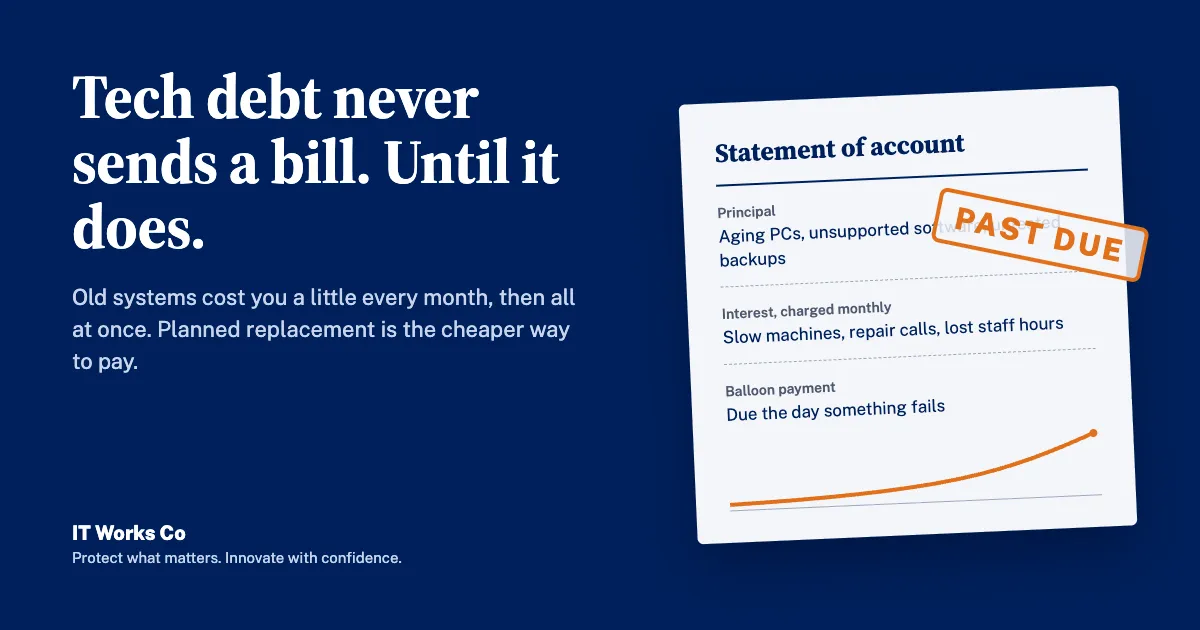
Tech debt works like a loan. The principal is the cost of fixing the problem; new computers, supported software, proper backups. The interest is what you pay every month you don't fix it. That includes slow machines, repair calls, workarounds, and staff time spent waiting on technology.
Then there is the balloon payment. An old system fails, gets breached, or loses support, and you pay the full cost anyway. The difference now you pay it on the worst possible schedule, with downtime and stress added.
Direct costs: emergency repair invoices, replacement hardware at rush pricing, and fees to stabilize failing systems.
Indirect costs: lost productivity, slower customer response times, and staff irritation from constantly working around unreliable tools.
Strategic costs: missed opportunities to adopt modern platforms, automation, and integrations that competitors are already using.
💡 Pro Tip: When you evaluate upgrades, compare the project cost against a realistic estimate of current monthly “interest", which looks like hours lost, tickets raised, and incidents handled.
What are the signs your business has tech debt?
Common signs include:
Computers more than four or five years old
Software that no longer receives security updates, including Windows 10
A critical system only one person understands
No clear record of what you are running or when it was last updated
📌 Key Takeaway: If you recognize more than one of these symptoms, you are already carrying measurable technical debt—and it is growing.
Why does tech debt matter more for small businesses?
Large companies have IT departments and refresh budgets. Most small and mid‑sized businesses run technology until it breaks, because the costs of old systems are spread thin and hard to see. Small businesses are also less able to absorb a major failure. A week of downtime can hurt a 20‑person manufacturer badly. A data breach can damage a law firm's reputation for years.
For owner‑managed firms, a single incident—ransomware on an old server, a failed backup, or a compromised email account—can erase months of margin. That's why proactive investment in modern infrastructure, secure configurations, and documented processes is not a luxury; it is risk management.
⚠️ Warning: If your business relies on one aging server, one key spreadsheet, or one staff member who “knows how it all works,” you have a single point of failure not a strategy.
What is the Productivity Mega Deduction?
The Productivity Mega Deduction is a proposed federal tax measure. It would let Canadian businesses deduct 100% of the cost of eligible assets, including computer equipment and software, in the year they are put into use. It is proposed to be permanent and applies to eligible property acquired on or after September 15, 2026.
💡 Pro Tip: Align your upgrade roadmap with your fiscal year so you can fully leverage immediate expensing when and if the measure comes into law.
How can the Mega Deduction help pay down tech debt?
Normally, the cost of new equipment is written off gradually over several years. Immediate expensing brings that deduction forward, which lowers the real cost of upgrading and frees up cash.
The Mega Deduction is still a proposal, and how it applies depends on your business. Talk to your accountant before making purchase decisions, but consider these opportunities:
Replace end‑of‑life servers and workstations before they fail, while maximizing tax efficiency.
Migrate to supported, secure software platforms without stretching cash flow as thinly.
Invest in modern collaboration tools, cloud services, and automation that reduce future tech debt.
📌 Key Takeaway: Use the Mega Deduction as a catalyst to convert hidden operational risk into planned, tax‑efficient investment.
What should you do next?
Start by knowing what you have. An IT audit shows exactly where your tech debt sits and what is urgent. It also shows what can wait. From there, you can build a phased replacement plan that fits your cash flow and your tax year.
At IT Works Co, that is the conversation we are having with clients this fall. Planned replacement is almost always cheaper than forced replacement.
Inventory your environment: hardware, software, licensing, and critical business systems.
Rank your risks: identify single points of failure, unsupported platforms, and security gaps.
Align with incentives: coordinate upgrades with your accountant to leverage available deductions.
Execute in phases: prioritize high‑impact, high‑risk items first, then modernize the rest.
💡 Pro Tip: Document your remediation plan. A clear, written roadmap not only guides investment, it also signals to insurers, lenders, and auditors that you are managing technology risk proactively.
Protect what matters. Innovate with confidence.
Ready to quantify and reduce your technical debt?
